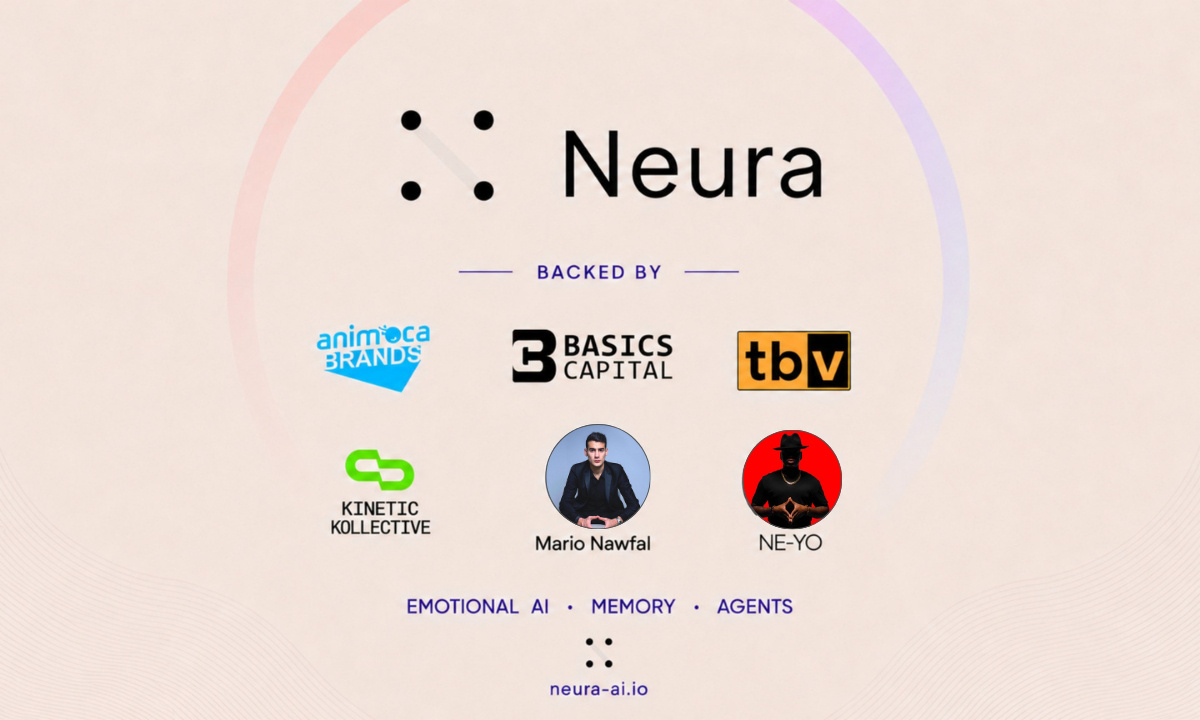
Neura, the protocol building what it describes as the world's first Emotional AI Economy, announced the close of a strategic funding round to accelerate development of AI agents with persistent emotional memory and user-owned identity. The round drew leading investors and partners across Web3, AI, and culture, including Animoca Brands, Basics Capital, TBV, Kinetic Kollective, Mario Nawfal, and Grammy Award-winning artist Ne-Yo.
The Specific Gap This Protocol Is Trying to Close
Today's AI is getting smarter every month, but it still forgets users the moment a session ends or devices change. It processes what people say, not what they feel. The agents interpret tone and emotional context, remember a user's emotional history across interactions, and adapt over time to build genuine, long-term relationships. That memory is anchored on-chain and owned by the user, rather than trapped inside a centralized app.
What the CMO Said About the Company's Core Thesis
Sahin Bayar, CMO, said emotional intelligence is the missing layer in AI, and memory is what makes it useful. He framed the whole industry's current race as focused on IQ, while the belief here is the next leap is EQ. He noted that the smartest tool in the world means nothing if it doesn't remember who a user is, positioning persistent, user-owned memory as the foundational capability the rest of the product is built around.
What the New Capital Will Actually Fund
The new capital will fund a three-phase roadmap. Neura Social is the consumer app where users interact with emotional AI companions. An AI SDK lets developers build agents that persist context and emotional state. The full protocol layer is a decentralized network with verifiable compute and community governance. That three-phase structure sequences a consumer-facing product first, followed by a developer platform, before reaching the fully decentralized layer.
How the On-Chain Memory Ledger Actually Works
Through the on-chain Memory Ledger, emotional context is preserved with privacy-first cryptographic proofs, portable across models, platforms, and devices, and even across physical embodiments, rather than locked inside one company's walls. That portability means a user's accumulated emotional context with an AI companion isn't tied permanently to a single app or vendor. It addresses a lock-in problem common to most existing consumer AI products.
Why Ne-Yo's Involvement Is Specifically Notable
The backing of investors spanning Web3 infrastructure, capital markets, and global culture, including Ne-Yo, whose involvement signals reach into the creator economy and entertainment, underscores growing conviction that emotionally intelligent, user-owned AI represents the next frontier for both consumer adoption and the broader AI economy. His participation extends the round's relevance beyond a purely Web3-native or technical investor base.
How the Broader Architectural Combination Is Framed
Trust through blockchain, aligned incentives through tokenomics, and empathy through emotional AI are united into what the company describes as a new class of long-lived, community-owned digital agents. That three-part framing distinguishes this stated approach from AI companion products built purely as centralized consumer apps without an underlying token or ownership layer.
What Builders and the Broader Community Are Invited to Do Next
Builders, creators, and the wider community are invited to join early as this Emotional AI Economy is built out, with more information available at neura-ai.io. That open invitation signals the current stage is still pre-full-launch. Community and builder participation is framed as part of the roadmap going forward, not a completed product already at scale.
Building persistent, portable, user-owned identity and memory layers like this reflects the same ownership-first design philosophy seen in Lock.com's isolated signing wallet architecture, both prioritizing user control over sensitive personal data and identity rather than centralizing it within a single company's infrastructure.
A related pattern shows up in ZetaChain 2.0 AI Interoperability Bets on Private Memory, where a comparable dynamic plays out in a different corner of the market.
Glossary
- On-chain Memory Ledger: A blockchain-based system for storing and verifying persistent context or history, here emotional interaction data, tied to a user's ownership rather than a centralized app.
- Privacy-first cryptographic proof: A verification method that confirms data authenticity or history without exposing the underlying sensitive content itself.
- Emotional AI: Artificial intelligence systems designed to interpret, remember, and respond to a user's emotional tone and context over time.
Disclaimer
This coverage is for informational purposes only and is not a substitute for financial or investment advice. Early-stage AI and Web3 protocols carry significant technical and market risk. Confirm current details directly through official Neura announcements.